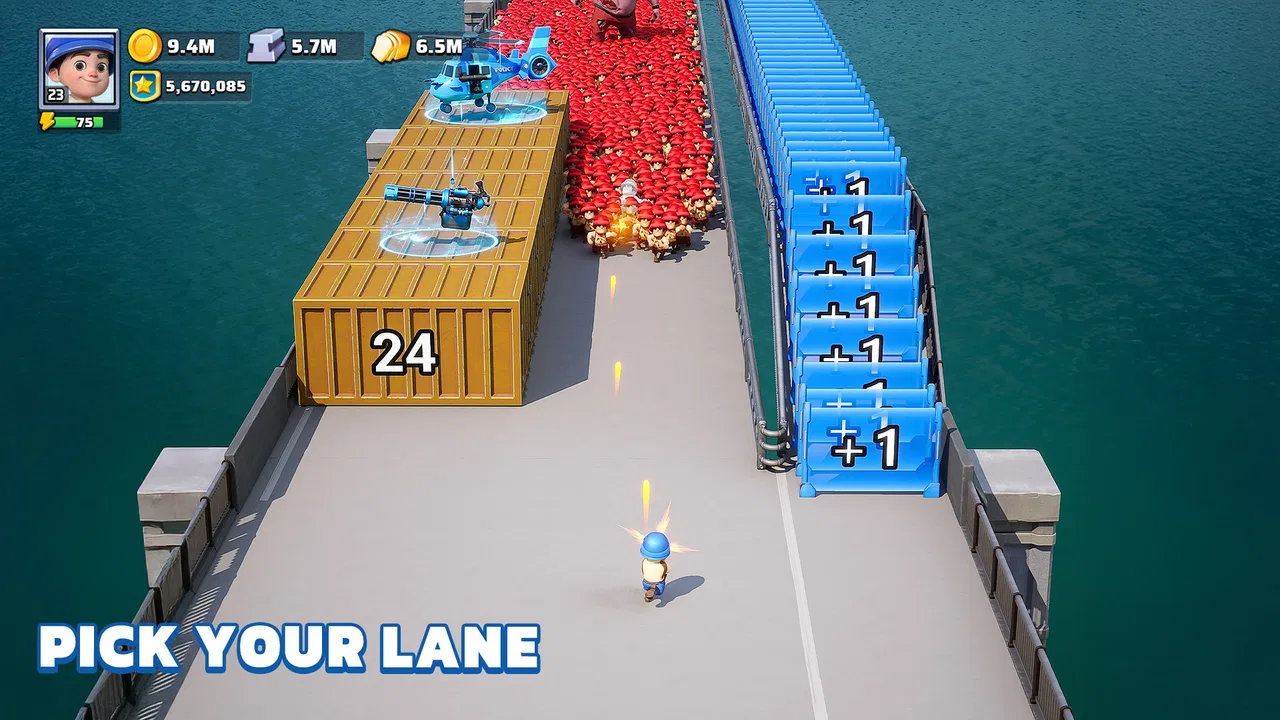
Last War:Survival Game
- 4.6
- Rating
- 100.00M
- Installs
- Free
- Price

 Analysis by App-foxy
I approached Last War:Survival Game as a mobile strategy game rather than as a quick zombie-themed distraction. Its central appeal is easy to understand: you are placed in a survival setting where decisions need to be made quickly, enemies create constant pressure, and progress depends on choosing what deserves your attention first. After spending time with it, my impression is that it works best for players who enjoy a steady stream of short tactical choices, but it is less suitable for anyone looking for a completely relaxed or purely offline-style experience.
The game is free to download, and it comes from FUNFLY PTE. LTD. It is listed for Teen audiences, runs on Android versions from 5.0 onward, and includes optional purchases priced from $0.99 to $99.99 per item. That range matters more than the “free” label alone. I could start without paying, but the presence of high-priced purchase options means I would approach the game with a clear personal spending limit rather than treating every offer as harmless background decoration.
How the survival strategy loop feels in everyday play
The strongest part of the experience is the way it turns a familiar zombie setting into a sequence of priorities. I was rarely thinking only about defeating the next threat. I was also considering whether to improve my current position, prepare for a later obstacle, or use a limited opportunity immediately. That combination gives the game more structure than a simple action title, while the quick-combat emphasis keeps it from feeling like a slow spreadsheet exercise.
You May Also Like

 Pandora - Music & Podcasts
Pandora’s Music Is Easy to Start, but Harder to Recover
Pandora’s strength is its low-effort path from a seed to a station. Its weak spot is how much confidence it asks you to place in connection, setup, and quiet recovery.

 8 Ball Pool
 Is Built on Rivalries, Rematches, and Routine
A close look at the rivalries, rematches, shared routines, and unanswered safety questions that turn a quick pool match into a persistent mobile community.

 Samsung Music
’s Quiet Strength Is Playing What You Already Own
Its reach comes less from spectacle than from dependable access to a personal library. That simplicity is both the app’s strongest retention engine and its ceiling.

 AccuWeather: Weather Radar
AccuWeather Review: A Quick, Clear Forecast for Everyday Decisions
For everyday plans, the best forecast is the one you can understand quickly. AccuWeather makes rain timing, radar, and local conditions easy to act on, with a few trade-offs.

 Hill Climb Racing
Why Hill Climb Racing Still Turns Crashes Into One More Run
A tiny car, a bumpy hill and one more upgrade: Hill Climb Racing keeps resurfacing because its simple chaos makes every near-miss feel personal.

 AliExpress - Shopping App
AliExpress Makes Global Shopping Feel Personal, but Shoppers Bear the Risk
AliExpress turns a global marketplace into a pocket-sized discovery engine. Its reach is useful, its shopping loop compelling, and its trade-offs easy to miss.
More From Our News Desk
View All News


In practical terms, this makes it easy to fit into small breaks. I can imagine opening it during a commute, between household tasks, or while waiting for an appointment, handling a few decisions, and returning later. The danger is that the short-session design can encourage repeated checking. A game that is convenient to play in small bursts can also become a habit of opening the app whenever there is a new task or reward waiting.
I found the best approach was to decide in advance what I wanted from a session. If I opened the game simply to collect everything available, I paid less attention to the strategic side. If I entered with one goal—improving a weak area, clearing a difficult encounter, or organizing my next move—the experience felt more deliberate. That is a useful distinction because the game can otherwise blur into a chain of taps and interruptions.
The zombie theme gives the decisions urgency, but the real attraction is not horror. Players who want frightening atmosphere, deep narrative, or a slow survival simulation may find the presentation less satisfying than a dedicated story-driven game. Here, the setting mainly provides context for pressure and progression. I enjoyed that focus, although I would not recommend it to someone choosing games primarily for character writing or cinematic storytelling.
Progress feels rewarding, but it asks for patience
Like many long-running mobile strategy experiences, the appeal depends on seeing a position improve over time. Early progress is usually the easiest to appreciate because each improvement feels meaningful. Later, the same loop can demand more patience. The important skill is learning to distinguish between a genuinely useful upgrade and an attractive distraction that only makes the interface feel busy.
My practical advice is to avoid spreading attention across every available option. Pick a clear priority and let the rest wait unless it directly supports that plan. This is especially helpful when the game presents several possible ways to become stronger. A broad collection of half-developed improvements may look impressive, but a focused approach is easier to understand and gives each session a purpose.
Another useful habit is to pause before spending any premium resource or accepting an immediate shortcut. The pressure of a difficult encounter can make a purchase or instant completion feel more valuable than it really is. I would first ask whether the decision solves a lasting problem or merely removes a few minutes of waiting. That question does not require any special knowledge, and it protects the free-to-play experience from becoming a series of impulsive choices.
The game’s quick-combat identity also creates a trade-off. It is approachable because I do not need to spend a long time preparing every move, but players who want precise control over every battle may find the strategic depth uneven. The satisfaction comes more from choosing a sensible direction and managing momentum than from manually directing every second of a fight.
What the purchase model means for a free player
The game can be played without an upfront payment, which lowers the barrier to trying it. However, free access and a completely pressure-free experience are not the same thing. Optional items span from $0.99 to $99.99, so the purchase system includes both small convenience spending and much larger commitments. I would not let a child use the purchase features without device-level controls, and I would personally remove saved payment details before experimenting with any offer.
I also recommend treating every purchase as a separate decision rather than assuming that a small first payment will remain small. A low-cost item may be reasonable for a player who already knows the game suits them, while a large bundle deserves a much more serious pause. The sensible comparison is not “cheap versus expensive”; it is whether the item changes how I enjoy the game or simply helps me move through the same loop faster.
There is an important limit to what I can responsibly conclude about spending. The purchase range is clear, but that alone does not establish how generous progression is, how often offers appear, or whether paying is necessary for a particular competitive goal. I would not promise that the game is perfectly balanced for non-spenders, and I would not claim that payment automatically guarantees an advantage in every situation. Those questions require personal observation over a longer period and can change as a live game develops.
For my own use, the safest arrangement would be a fixed monthly budget—or no budget at all—combined with a rule that I never buy while frustrated by a failed attempt. That is more useful than trying to predict the value of every individual offer. If the game stops feeling enjoyable without spending, that is a sign to step away rather than escalate the purchase.
Fairness depends on how you define competition
The question of fairness is more complicated than whether a game is free to install. In a strategy game with optional purchases, I want to know whether success comes mainly from planning, whether time investment matters more than money, and whether players are placed into situations where spending feels unavoidable. The available purchase information confirms the monetization range, but it does not by itself answer those gameplay questions.
My honest position is cautious. I would enjoy the game as a personal progression challenge, where improving my own decisions is the main objective. I would be more hesitant if my enjoyment depended on proving that I could match players who spend heavily. That distinction helps avoid disappointment: a free player can have a worthwhile experience without assuming that every competitive environment will feel identical for every budget.
If competition is your main reason for installing, spend time learning the ordinary progression loop before buying anything. Watch how much progress comes from simply playing, notice which obstacles repeatedly stop you, and decide whether those obstacles are interesting challenges or irritating walls. Only then can you judge whether the game’s economy fits your expectations. I would not use the high rating alone as evidence that the competitive model will suit every player.
There is also a social aspect to fairness that I would consider before committing. If friends or a group invite me to participate, the pressure can become stronger because I do not want to be the person slowing everyone down. In that situation, I would agree on expectations early: am I joining casually, or am I expected to keep pace with serious players? A clear answer prevents the game from turning a friendly activity into an unwanted spending obligation.
Who will enjoy it, and who should skip it?
I would recommend Last War:Survival Game to someone who likes mobile strategy with a dramatic survival theme, short sessions, and a sense of ongoing improvement. It is a good fit for players who enjoy deciding what to prioritize, returning regularly to build momentum, and accepting that progress may be more satisfying when it is planned rather than rushed.
I would be less likely to recommend it to someone who dislikes recurring mobile-game pressure, wants a single purchase with a clearly finished experience, or prefers battles with detailed manual control. It is also not my first choice for a player seeking a quiet game to play without thinking. The zombie setting may sound casual, but the constant need to choose, improve, and respond can make the experience mentally active.
Compared with a traditional turn-based strategy game, this one is easier to sample in short bursts and less dependent on carefully calculating every individual move. Compared with a straightforward action game, it asks for more long-term planning and less moment-to-moment reflex work. Compared with a premium offline strategy title, the free entry is more accessible, but the optional purchase structure requires more self-control. Those differences are more important than the theme when deciding whether it belongs on your phone.
Rating, reach, and what they do—and do not—tell me
The game has an average rating of 4.7 from around 1.7 million ratings, with roughly 25 thousand written reviews and over 50 million installs. That level of reach tells me it has found a large audience and that the basic concept is appealing to many mobile players. It does not guarantee that the monetization, pacing, or competitive balance will match my personal preferences.
It was released on June 8, 2023, so I would approach it as an established mobile title rather than a brand-new experiment. That makes the large audience easier to understand, but it also means I would expect a player to have a clear opinion about the game’s long-term loop before investing money. A popular game can still be the wrong choice for someone who dislikes its particular rhythm.
The Teen rating is another practical consideration. I would not interpret it as a recommendation for every teenager, especially where optional purchases are involved. Families should combine the age label with their own rules about screen time, spending, and the kind of pressure they are comfortable with in a game. For adults, the rating mainly signals that this is not designed as a child-focused experience.
My trust verdict after weighing the trade-offs
My overall view is positive but measured. The game has a clear identity: quick survival-flavored combat supported by strategic choices and gradual progress. I like that it can fit into ordinary spare moments, and I think its best moments come when I resist the urge to rush and instead make a focused plan. The main friction is not the basic concept; it is the need to manage attention and spending carefully around a free-to-play structure.
The most trustworthy way to approach it is as a free trial with a personal spending boundary, not as a promise of unlimited free progress. Play long enough to understand whether the decisions themselves are enjoyable. If they are, the game can become a satisfying routine. If the only appealing part is the feeling of getting past the next obstacle quickly, I would stop before convenience purchases become the reason I continue.
FUNFLY PTE. LTD. has made a strategy game that is easy to start and broad enough to attract a substantial audience. I would recommend downloading it to players who specifically want a zombie survival setting wrapped around mobile strategy, especially those comfortable with regular short sessions. I would skip it in favor of a premium or more self-contained alternative if I wanted a one-time purchase, a calmer pace, or competition where spending is not part of the conversation.
In the end, I would keep it installed only if the planning remains enjoyable after the initial excitement fades. That is the test I trust most. The free entry makes trying it simple, the strong audience response makes it worth considering, and the purchase range makes restraint essential. For the right player, that balance works; for everyone else, the game’s popularity should not override a clear preference for a different kind of strategy experience.
FAQs for Last War:Survival Game
01What is the main objective of Last War: Survival Game?
In Last War: Survival Game, the primary goal is to survive in a post-apocalyptic world by gathering resources, building shelters, and defending against enemy attacks. Players must strategize and collaborate with others to form alliances, making critical decisions that impact their survival and progression in the game.
02Is Last War: Survival Game free to play, and are there in-app purchases?
Yes, Last War: Survival Game is free to download and play. However, it offers in-app purchases that can enhance the gaming experience by providing access to special items, resources, and faster progress. While these purchases can be advantageous, they are not necessary to fully enjoy the game.
03What platforms is Last War: Survival Game available on?
Last War: Survival Game is available on both Android and iOS platforms. Players can easily download it from the Google Play Store or Apple App Store. Ensure that your device meets the minimum system requirements for a smooth and enjoyable gaming experience.
04Does Last War: Survival Game require an internet connection to play?
Yes, an internet connection is required to play Last War: Survival Game. The game features online multiplayer elements, including alliances and player-versus-player battles, which necessitate a stable internet connection. This connectivity allows for continuous updates and real-time interactions with other players.
05Can I play Last War: Survival Game with friends?
Absolutely, Last War: Survival Game encourages social interaction by allowing players to team up with friends. You can form alliances, strategize together, and support each other in battles against enemies. The game’s cooperative features add an engaging layer of teamwork and competitive excitement.
Pros
- Engaging storyline with immersive elements.
- Diverse character customization options.
- Smooth graphics and intuitive controls.
- Regular updates with new missions.
- Strong community support and alliances.
Cons
- In-app purchases can be pricey.
- Occasional server downtime issues.
- Requires stable internet connection.
- Battery consumption is relatively high.
- Tutorials can feel overly lengthy.

Last War:Survival Game
Gallery